A shallow mount subwoofer is the usual answer when you want real bass in a truck but have no trunk. Regular cab and many crew cab pickups only offer a few inches under or behind the seat, and a standard subwoofer is simply too deep to fit there. Shallow subs use a flatter motor and basket so they can live in a thin box. This guide covers measuring, picking a size, and getting a clean install.
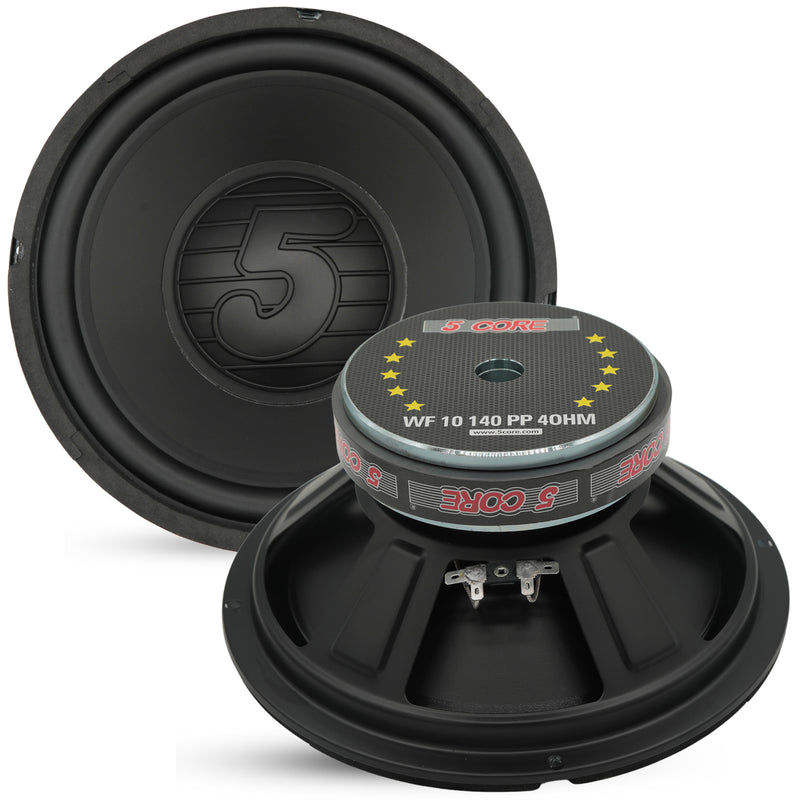
Door speakers cannot reproduce the lowest notes well, and trucks often have thin doors and lots of road noise. A sub fills that gap. The problem is space: under-seat and behind-seat areas are wide but shallow. A shallow-mount design trades some depth for a slimmer profile, which is exactly the constraint in a pickup.
| Size | Good for |
|---|---|
| 8 inch | Tightest spaces, regular cabs, a little extra punch |
| 10 inch | The common middle ground for under-seat boxes in crew cabs |
| 12 inch | More output if you have the width and height, often behind the seat or in an SUV |
Bigger is not automatically better in a truck. A 10 that fits a properly sized box usually sounds better than a 12 crammed into a box that is too small for it.
Every subwoofer needs an enclosure; a bare sub sitting on the floor will sound weak because the front and back waves cancel. Most under-seat setups use a sealed box because it is compact and forgiving. Build or buy a box with the internal volume the sub's manufacturer recommends, and seal every seam. Wedge-shaped boxes that match the slope behind a seat are common. (Evoxen USA does not sell enclosures, so you will need to source the box separately.)
A subwoofer needs an amplifier; a head unit cannot drive one properly. Match the sub's RMS rating, not its peak rating, to the amp's output at the impedance you wire it to. Most single-voice-coil subs are 4 ohms. Dual voice coil subs can be wired to different final loads, which our subwoofer impedance wiring guide explains. Then set the gain carefully with the method in how to set car amplifier gain so you do not clip and damage the coil.
For tight spaces see the 5 Core 8" shallow-mount car subwoofer; the 5 Core 10" shallow mount subwoofer, 4 ohm is our go-to for crew cab under-seat builds, and the 5 Core 12" car subwoofer for SUV and truck suits larger spaces. Check each listing's mounting depth against your box. Pair it with upgraded doors from our 6.5 coaxial speaker guide.
A single voice coil (SVC) sub has one set of terminals, usually 4 ohms, and is the simplest to wire. A dual voice coil (DVC) sub has two coils, which lets you wire it in series or parallel to present a different final load to the amplifier. That flexibility helps when you want to run two subs, or when your amp makes more power at a lower impedance. If you are not sure, a single 4-ohm sub keeps things simple.
Trucks have small cabins, which naturally boost low bass compared with a large room. That means a modest sub can sound bigger than you expect. Set the low-pass filter so the sub hands off smoothly to the door speakers, and keep any bass boost off at first. Sit in your normal seat to judge the result, not outside the truck with the door open. If the bass sounds boomy on one note, lower the crossover point slightly or reduce the gain.
It is a design trade-off. In the right box it sounds solid; its advantage is fitting where a regular sub cannot.
Only very slim powered units usually fit there. Under or behind the rear seat is far more common.
Sealed, in most trucks. Ported boxes need more volume than under-seat spaces usually give.