A PA horn speaker for outdoor use is built for one job: throwing clear voice announcements a long way, in the open, in any weather. You see them on barns, sports fields, parking lots, warehouses and boats. Horns are efficient and directional, which is why a modest amplifier can be heard across a large area. They are not hi-fi speakers, and that is fine; for paging and announcements, intelligibility is what counts.
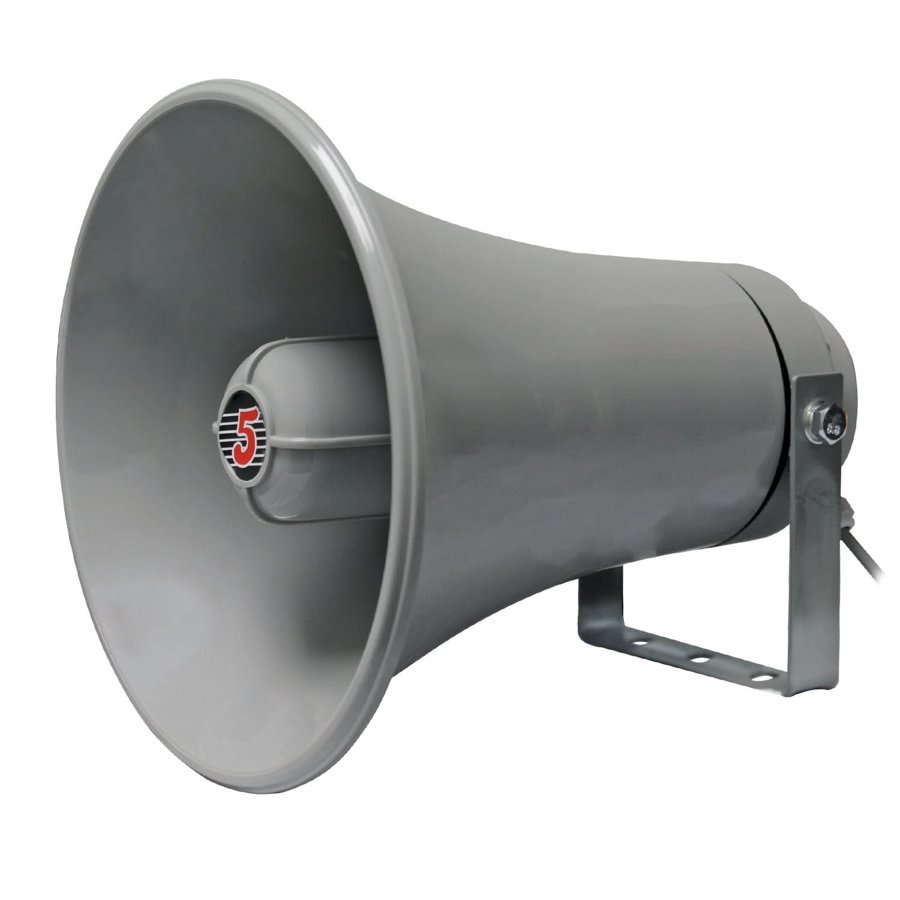
Horn size is usually given by the bell diameter. Larger bells generally project further and handle lower frequencies better. Smaller horns are fine for a patio, a shop or short-range paging. For a field or large lot, use several horns aimed at different zones rather than one huge horn turned all the way up; coverage is more even and the sound is less harsh up close.
This is the main technical choice. An 8-ohm horn connects directly to a standard amplifier, like a home or pro audio speaker. That is simple for one or two horns. Large installations with long cable runs and many horns often use 70V or 100V systems with transformers on each speaker. Check what your amplifier supports before buying and do not mix the two. For wiring several 8-ohm horns, see how to wire multiple PA horn speakers: the combined load must stay within what the amp can handle.
Many PA horns are a bell plus a separate driver. If one stops working, you may be able to replace the driver instead of the whole horn. Match thread or bolt pattern, impedance and power handling; our guide to choosing a PA horn and compression driver covers how.
Start with the amplifier low and raise it while someone walks the coverage area. If voices sound harsh or crackly, you are probably clipping the amp; turn the gain down and add another horn instead. Using a decent wired mic such as one from our dynamic microphone XLR setup guide keeps announcements clean.
5 Core horns on Evoxen USA include the 6" PA horn speaker for patios and shops, the 9" all-weather PA horn speaker, 8 ohm, and the 10" PA horn loud speaker for longer throw. For replacement drivers see the 5 Core 1" compression driver and the paging horn throat.
Before buying, walk the area and note where people will actually stand, where noise comes from (machinery, roads, crowds), and any buildings that will block or reflect sound. Mark possible mounting points on poles, eaves or walls. Aim each horn so its coverage overlaps slightly with the next one. Remember that sound drops off quickly with distance outdoors, so two horns at moderate level placed closer to listeners usually beat one loud horn far away. Think about neighbors too: pointing horns toward your property and away from homes keeps everyone happier.
For 8-ohm horns, use speaker cable thick enough for the run length; long runs with thin wire lose power. Our speaker wire gauge guide explains how to pick a gauge. Outdoors, use cable rated for UV and moisture, and protect connections inside weatherproof boxes. Label each run so troubleshooting later is easy.
Once or twice a year, check that brackets are tight, cable jackets are not cracked, and nothing (insects, nests, debris) has blocked the bell. A quick listening test after storms helps catch water damage early.
In short: choose horn size by distance, match 8-ohm or 70V to your amplifier, mount high and angled to drain, and cover the area with several horns at a sensible level.
It will play music, but horns are tuned for voice. Expect limited bass.
It depends on area and noise. Cover zones with several horns at moderate volume rather than one at maximum.
All-weather horns are designed for it, but mounting angle and sealed connections make a big difference to lifespan.