The 6x9 vs 6.5 car speakers question comes up constantly, and the honest answer is that your car usually decides for you. These are different shapes for different openings. A 6x9 is an oval speaker, roughly 6 by 9 inches, usually found in rear decks and some front doors. A 6.5 is round and is the most common door speaker today. Below is how they differ, when you have a real choice, and how to check before buying.
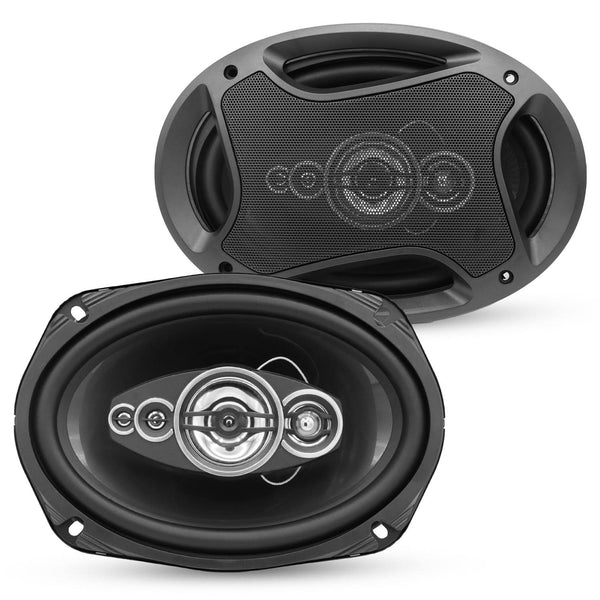
| 6x9 (oval) | 6.5 (round) | |
|---|---|---|
| Typical location | Rear deck, some truck and older-car doors | Front and rear doors in most modern vehicles |
| Cone area | Larger | Smaller |
| Bass | More low end from a door or deck | Tighter; less deep bass |
| Fit flexibility | Needs an oval opening or adapter | Fits a huge range of vehicles |
Bass is about moving air. The oval cone of a 6x9 has more surface area than a 6.5-inch round cone, so it can move more air at low frequencies. That is why rear-deck 6x9s became popular in sedans: the trunk behaves like a big enclosure and the deck fires sound into the cabin. In practice a good 6x9 can fill in the low end noticeably better than a round door speaker, though neither will replace a subwoofer.
Modern doors are built around round openings. A 6.5 drops in with an adapter ring at most, keeps the factory grille, and is easier to aim. Front doors also matter more for sound quality than rear decks, because the sound stage should be in front of you. So for most drivers the first upgrade is a pair of round front-door coaxials. Our guide to choosing 6.5 coaxial car speakers covers that in depth.
Not without cutting, and we do not recommend it. Some adapter plates go the other way, letting a 6.5 sit in a 6x9 opening. That works but you give up the extra cone area that made the 6x9 attractive. If your vehicle has 6x9 openings, use 6x9s.
The full measuring method is in our car speaker size guide.
Whatever the shape, compare RMS (continuous) power rather than peak numbers, look at sensitivity if you are keeping the factory radio, and stick with 4 ohms for nearly all car head units. A 6x9 does not need a different radio or wiring than a 6.5.
Lots of sedans and trucks have 6.5s in the doors and 6x9s in the back. A common, budget-friendly approach is to upgrade the front doors first, then the rear 6x9s, and add a compact sub if you still want more bass. Doing it in that order means each step makes an audible difference. See the factory speaker upgrade guide for the full sequence.
For oval openings: 5 Core 6x9 4-way coaxial speakers. For round door openings: 5 Core 6" 2-way coaxial door speakers. For small dash or compact-car spots: 5 Core 4" 2-way coaxial speakers.
Clarity depends far more on the individual speaker design and on installation than on shape. A round 6.5 tends to have a slightly more even response off-axis because the cone is symmetrical, which can help imaging in the front doors. A 6x9 in a rear deck is typically aimed up at the rear window, so its sound bounces around the cabin; that is fine for fill and bass, less ideal for precise vocals. This is another reason to spend your effort on the front doors first.
Because 6x9s have larger cones and often more drivers, they can cost a little more per pair. If your budget only covers one pair, front-door round speakers usually give the more noticeable upgrade. If your car has 6x9s in the front doors, as some trucks and older vehicles do, then the 6x9 is your front speaker and the choice is made for you.
Not necessarily louder; loudness depends mostly on sensitivity and power. They usually produce more bass.
Yes, as long as both are the impedance your radio expects, usually 4 ohms.
If you want deep bass, yes. 6x9s help, but a sub handles the lowest notes far better.